
The Guardian: UAE Becomes Top Investor in Africa Despite Human Rights Issues
The UAE has become the largest supporter of new business ventures in Africa, raising hopes for a crucial influx of funds for green energy. However, it has also sparked concerns that these investments may endanger workers’ rights and environmental protections.
The Guardian highlighted that between 2019 and 2023, UAE companies announced projects worth $110 billion (£88 billion), with $72 billion allocated to renewable energy, according to FT Locations, a data company owned by The Financial Times.
The value of these commitments is more than double the commitments made by companies from the UK, France, or China, which withdrew from major infrastructure projects in Africa after many failed to meet expected returns.
African leaders also expressed disappointment with Western governments’ climate finance pledges. At the Cop29 climate conference, for instance, wealthy nations promised $300 billion annually, while developing nations requested $1.3 trillion.
While African leaders have welcomed the growing interest from the UAE, some activists and analysts have expressed concern that the UAE’s poor record on migrant workers’ rights, its ongoing support for hydrocarbons, and its failure to address environmental concerns could negatively impact its investments in Africa.
Ahmed Abu Douh, an associate fellow at Chatham House, said: “African countries are desperately in need of these funds and energy transitions. The UAE investors are filling huge gaps that the West has failed to fill. But at the same time, they come with less interest in labor rights and environmental standards.”
The UAE has long been a political force in North and East Africa, accused of stoking conflicts in Libya and Sudan. Now, the country is seeking to diversify its economy beyond oil and gas, including green energy and “critical minerals” like copper, essential for electric cars and batteries.
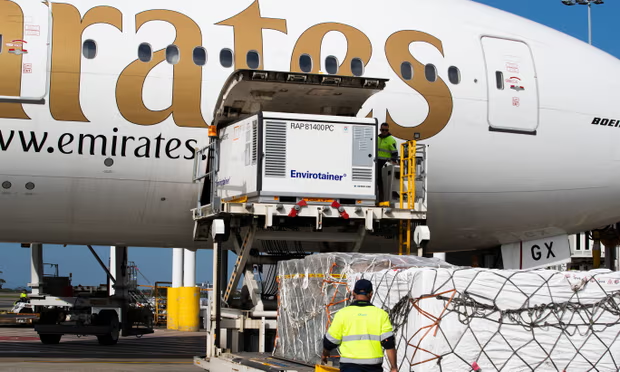
Dubai’s port and airline companies were among the first to expand into Africa. Emirates Airlines, based in Dubai, now operates flights to 20 African countries.
DP World, Dubai’s state-owned port operator, has been in the region since 2006. It operates six ports and plans to build two more. Abu Dhabi Ports has run the Kamsar port in Guinea since 2013 and recently won concessions in Egypt, the Republic of Congo, and Angola.
Madalena Procopio, a senior policy fellow at the European Council on Foreign Relations, stated: “Angola is currently the only country where both DP World and Abu Dhabi Ports are present.”
She added that the UAE has not ignored East Africa, noting the increasing interest from Abu Dhabi in expanding connections toward the Americas, particularly Latin America.
UAE companies are also investing in agriculture and telecommunications. Since 2022, Sheikh Ahmed Dalmouk Al Maktoum, ruler of Dubai, has brokered deals to sell carbon credits from forests covering one-fifth of Zimbabwe, 10% of Liberia, 10% of Zambia, and 8% of Tanzania.
UAE investments have also had an impact on the mining industry. International Resource Holdings (IRH), part of a conglomerate controlled by Abu Dhabi’s National Security Advisor Sheikh Tahnoun bin Zayed, paid $1.1 billion to Zambia’s state-run ZCCM for a 51% stake in Mopani Copper Mines.
This deal came as a surprise to many observers. ZCCM had taken over the heavily indebted mine from Glencore in 2021 and was looking for a new investor. Throughout 2023, reports widely indicated that the shortlist was down to two companies: Chinese Zijin Mining and South Africa’s Sibanye Stillwater.
However, this did not materialize until IRH was revealed as the favored company. Sheikh Tahnoun’s company, often regarded as the second most influential businessman in the UAE after Abu Dhabi’s ruler Sheikh Mohammed bin Zayed, had no prior experience in the sector.
Zambian officials and advisors, however, said that IRH had hired top-tier global mining experts and that their commitment to invest in the mine while protecting jobs made them the best option.
Many of the UAE announcements may not come to full fruition or are still in the early stages. For instance, the $34 billion “green hydrogen” project in Mauritania announced in 2023 was a memorandum of understanding rather than a contract.
Some pledges have also faced setbacks. In January 2023, Masdar, a renewable energy company, announced a $2 billion commitment for solar projects with a 2-gigawatt capacity in Zambia.
However, Gitu Kayumba, the special assistant to Zambia’s president, stated that financial issues at the state-owned ZESCO had delayed the investments.
Meanwhile, the amount of illegally smuggled gold from Africa to Dubai has risen, according to researchers. Swiss NGO Swiss Aid found a discrepancy of 2,569 tons between official exports from African countries to the emirate and its imports from Africa from 2012 to 2022, totaling $115.3 billion.
Ken Opalo, an assistant professor at Georgetown University, commented: “African countries need all the funding and trade they can get. But there’s also a chance to draw attention to crime – as we see in the gold sector.”

